Home / AI for Maintenance and Material Flow
Evidence first. Better maintenance decisions.
AI connects sensor trends, vision and load events to an asset, a proposed action and its effect on material flow. It supports a reviewed decision; it does not prove a fault or replace independent safety controls.
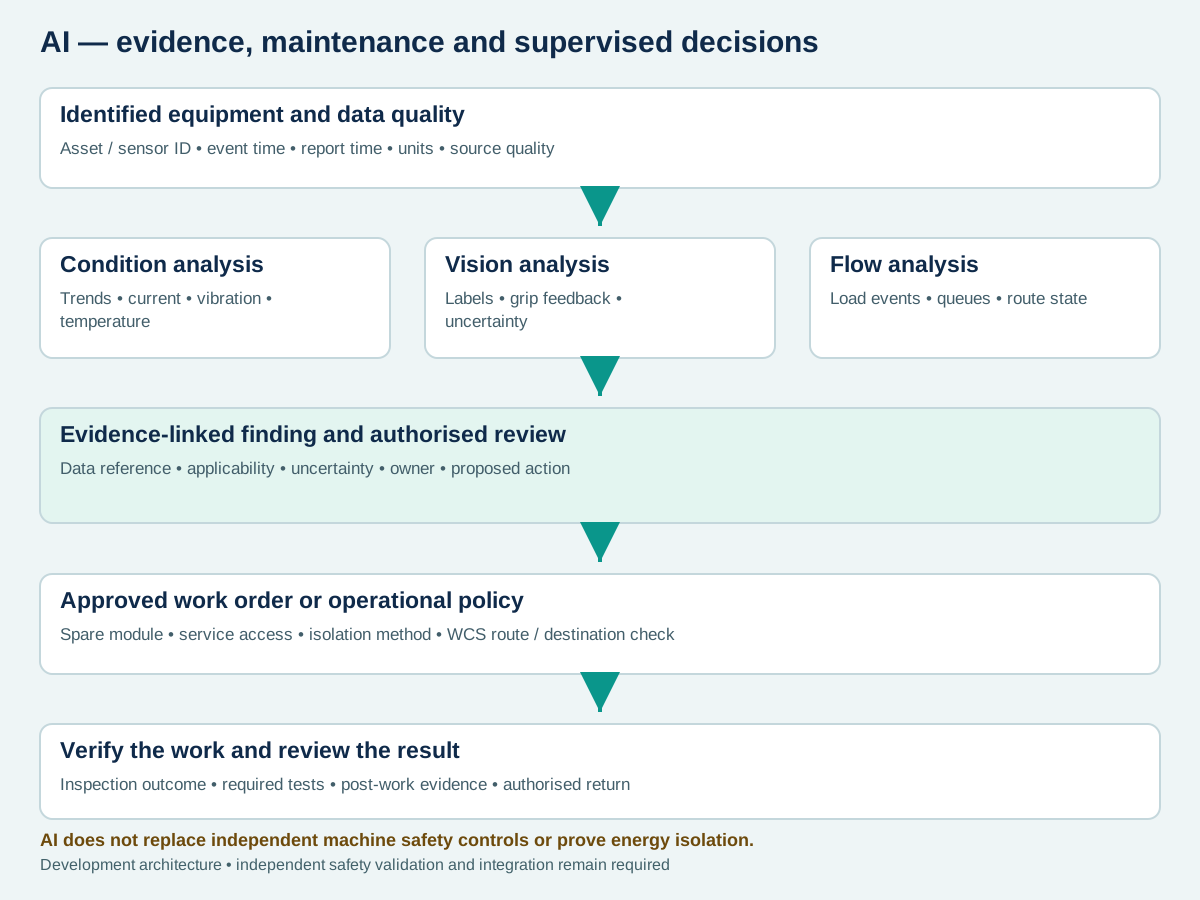
Sensor → finding → work → verified return.
The aim is shorter avoidable maintenance interruptions and more useful operating time. A recommendation must identify the asset, evidence and responsible person.
Measure the right point
Keep asset and sensor IDs, mounting point, units, relevant calibration status, timestamps and source quality.
Show the evidence
Compare trends and events with operating context. Show uncertainty and alternative explanations; a model output is not a diagnosis.
Plan practical work
Identify the spare module, tools, service access and affected routes. WCS checks remaining connections and destinations.
Verify the result
Record inspection, replacement and required tests. Review post-work data and authorised return before closing the finding.
A defined job for each equipment type.
These are proposed uses. Sensor selection, model performance and operational response need verification on the intended equipment and data.
| Equipment | Evidence | AI advice | WCS / operator action |
|---|---|---|---|
| Pallet storage and lifts | Motor vibration and temperature, current, encoder position, lift and load events | Flag an abnormal trend or repeated transfer delay, with the affected asset and evidence | Review the finding, plan a spare module and check an available lift or route through WCS |
| Tote storage and carriers | Position events, transfer confirmations, carrier faults and drive trends | Highlight repeated stalls, inconsistent locations or growing queues | Reconcile tote ID and slot, inspect the asset and admit work only to available routes |
| Conveyors and transfers | Photo-eyes, current, vibration, temperature, belt tracking and zone timestamps | Prioritise possible wear, abnormal running or a recurring transfer bottleneck | Create an inspection task; WCS removes an unavailable zone and checks the proposed bypass |
| Sorting and identification | Scanner and camera results, no-read events and exception outcomes | Suggest re-read or manual review, with an image reference and validated uncertainty measure | Use a defined exception destination; do not assume every unread load can be identified |
| Picking and decant | Vision, pick attempts, grip feedback, load IDs and cell events | Flag uncertain picks, repeated grip failure or poor presentation | Request operator review or reassign to an available, compatible cell or assessed manual station |
| AMR and AGV fleet | Robot status, position quality, task delay, battery and charging events | Suggest congestion, charging or inspection priorities | Fleet manager and WCS apply approved rules; independent robot protective functions remain separate |
| Dock loading and unloading | Case vision, grip/vacuum feedback, dock state and handover events | Highlight uncertain handling, a load-plan mismatch or recurring dock delay | Hold the task for review or use another compatible dock only where its physical route is available |
| Cold stores and utilities | Temperature, door state, refrigeration alarms, energy and reporting quality | Flag drift or an unusual energy pattern for inspection | Notify the responsible team and retain records; this is not proof of food safety or a refrigeration guarantee |
Make the repair practical before raising the alert.
An alert is useful when the team can locate the asset, reach it, obtain the right part and understand the impact on operation.
A replaceable module
Link each finding to a compatible drive, roller, lift or carrier module and spare. Measure swap times before publishing them.
A planned access route
Identify the service bay, level, stair and handling path. Access and isolation follow the approved site method, not an AI instruction.
A visible operating impact
Show affected inlet, lift, buffer and cell, and whether an alternate route is reachable. A shared failure can still stop a wider area.
A measured outcome
Track alert quality, confirmed findings, diagnosis time, active repair time and return-to-service checks against an agreed baseline.
Unavailable data must look unavailable.
Missing, stale, poor-quality or contradictory input must not quietly produce a healthy status or a confident recommendation.
Trace every observation
Keep source ID, event time, report time and units. Link the readings or image and model version behind the finding.
Explain the limitation
Show uncertainty and applicability. Validate what any confidence score means; a high score is not proof of a physical fault.
Use a defined fallback
Flag degraded inputs, suppress unsupported advice and use the configured inspection or operational fallback. Safety remains independent.
Separate advice, execution and protection.
The local review shows proposed responsibilities; it does not establish deployed AI, validated sensors or production connections.
AI advises with evidence
AI may rank findings, flag uncertain vision, suggest slotting or propose queue-reduction options. New policies need evaluation and authorised approval.
WCS applies approved constraints
WCS and machine controllers handle identity, occupancy, reservations and handshakes. They reject unavailable destinations and incompatible tasks.
Independent controls protect
Risk assessment defines and validates machine safety functions. AI and WCS must not bypass a safety inhibit or prove energy isolation.
Observe. Evaluate. Approve. Measure.
Advance when the acceptance evidence is ready, rather than promising a calendar date or fixed warning period.
Establish the baseline
Verify installation and event quality across relevant machine states. Record operating conditions and known faults.
Run in shadow mode
Compare advice with reviewed findings. Measure false alarms, missed cases and the limits of the available data.
Release a bounded use
Agree who accepts advice, allowed actions and how the use can be disabled. Test related WCS and machine responses.
Review actual results
Compare outcomes with the baseline, keep an audit trail and revise models and rules through controlled change.
AI questions.
Practical questions
Can AI start or stop a machine by itself?
The proposed role is advisory. Operational changes use authorised policies and machine interfaces, remain subject to independent safety controls and require configuration-specific validation.
Does every alert mean a bearing is failing?
No. Vibration, temperature or timing changes can have several causes. A finding presents evidence and limitations for an authorised person to review.
Does our data leave the site?
Processing may be local, cloud-based or combined. Collection, permissions, transfers, retention and outage behaviour must be agreed before connection.
Is this showing real customer readings?
No. The public dashboard and local review use simulated examples. Production measurements and AI performance require separate verification.
Start with the flow and the maintenance problem.
Share load types, equipment, destinations, recurring delays and maintenance constraints. We will define the evidence, interfaces and acceptance cases with your team.