Home / Tote ASRS
A floor that moves. Two travel lanes.
Eight levels and 1,152 tote places in an 18.9 m store. On every level, thin carriers glide on a magnetic floor through a central runway with two one-way lanes, one each direction, and lift each tote 1 cm off its support bars. Two tote rows sit on each side of the runway. Four independent continuous-loop lift units, two at the west end and two at the east end, feed four operator stations.
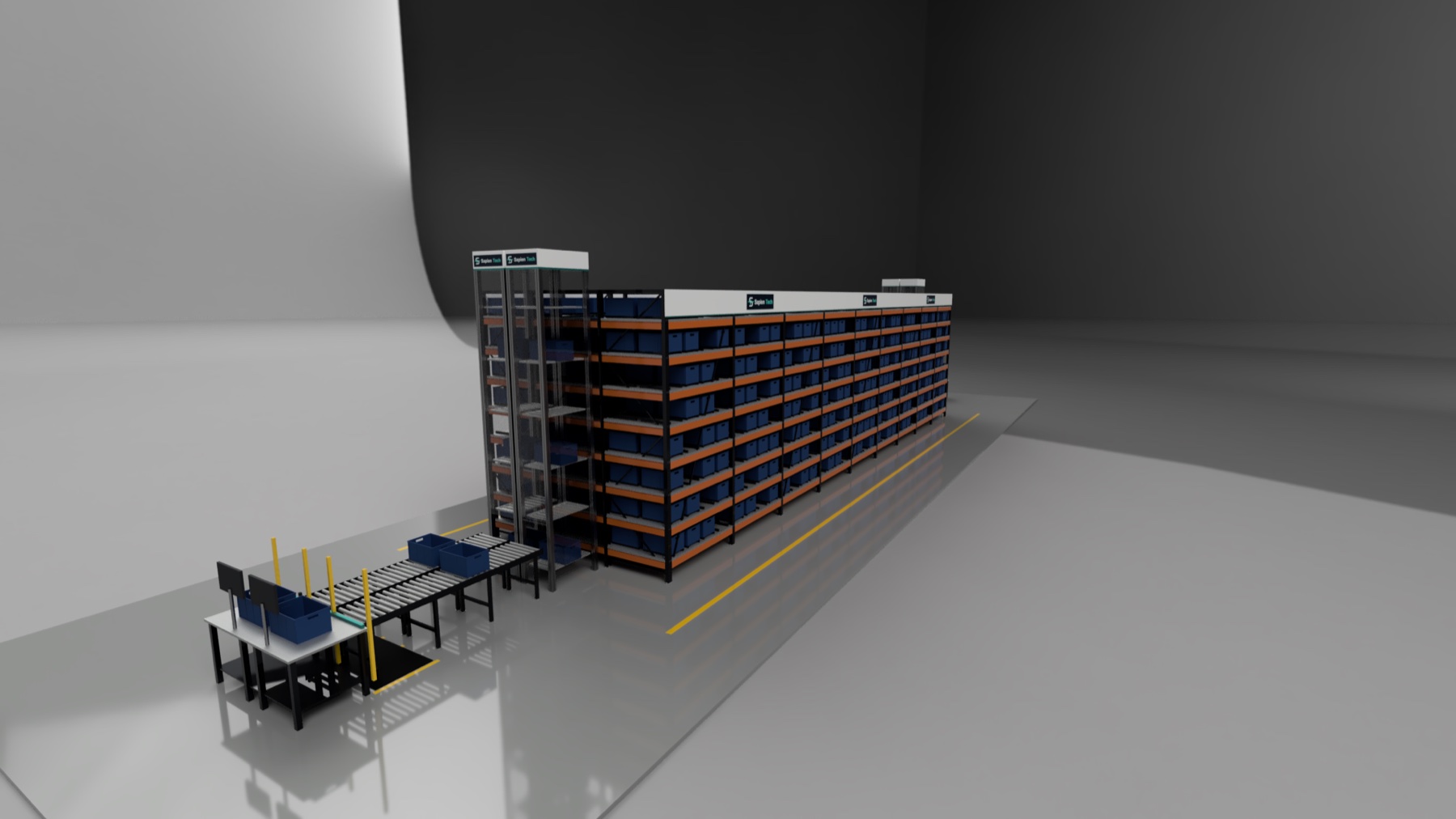
Two travel lanes. Four loop lifts.
This interactive model shows our earlier, shorter layout: four tote rows on each side and about 10 m long, with the same 1,152 places, two lanes and four loop lifts as the design above. Use the Double travel lanes camera to inspect the two separate routes in the middle. One carries westbound traffic and the other eastbound traffic. The coils under the glass push the thin carriers. Choose West pair or East pair to see the adjacent lifts, or Downstream station to follow their conveyors to the operator.
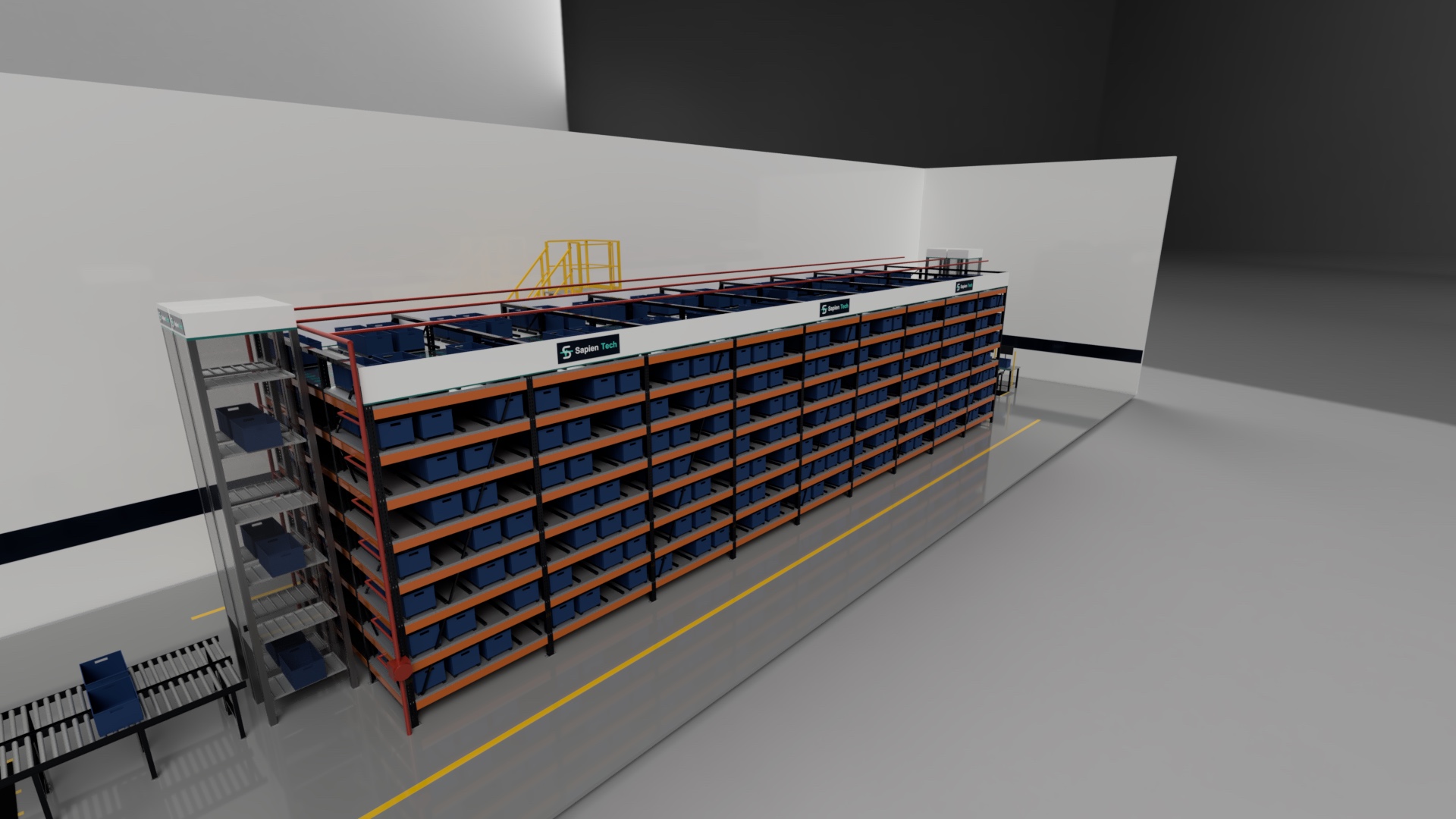
- Double travel lane. Two physical one-way lanes run through the central pickup area on every level, one westbound and one eastbound. In this earlier model, four storage rows sit on either side; the current design has two. Slot branches and lift handovers are controlled transfer points.
- Magnetic floor. Coils in the floor push magnets in the carrier. No wheels, no batteries, no charging stops.
- Always re-sorting. The model has 32 active magnetic floor carriers for storage, retrieval and re-sorting, plus one pictured service spare. Moving busy totes towards the front is intended to reduce digging.
- Yellow bars, not legs. Totes rest on two low bars. The carrier drives between them and lifts the tote 1 cm.
- Four up/down loop units. Two directly side by side at the west end and two at the east. Each independent unit has 16 moving carriages: 64 in total. The illustrated loop step is 1.5 seconds through all 8 levels; this is not a measured system rate.
- Two zones. The model illustrates barriers on every level and both east loop units stopped during zone B service. Continued operation elsewhere needs validated safety separation. See it →
What is in the model.
Design figures for the store in the main image (engineering model R12). They are design calculations; none are tested yet. On a phone, swipe the table sideways.
| Item | Value | Type |
|---|---|---|
| Tote size | 600 × 400 × 280 mm (standard Euro size) | Design |
| Tote weight | Up to 30 kg with goods | Target |
| Tote places | 1,152 nominal positions (72 per side per level: 2 rows deep each side of the double lane, × 8 levels) | Model |
| Store size | 18.9 m storage length; about 21.7 × 4.3 m overall, 4.9 m high (12 totes per m² of floor) | Model |
| Travel lanes | 2 one-way lanes on every level: westbound and eastbound, connected to the four lift units | Model |
| Levels | 8, at 570 mm pitch | Model |
| Carriers | 32 active on the magnetic floors, no batteries; 1 pictured service spare | Model |
| Up/down loops | 4 independent units: 2 west + 2 east, with 16 carriages each (64 total) | Model |
| Pick ports | 4 downstream stations, one connected to each loop unit | Model |
| Port rate | 400 totes an hour per station (design calculation) | Target |
| System rate | 1,600 totes an hour, set by the four stations (lifts about 1,800/h, carriers more). Digging for back-row totes is not yet modelled; to be simulated | Design calculation |
| Work height at the port | 900 mm | Design |
| Zones | 2 proposed service zones; adjacent operation subject to safety validation | Design |
| Every tote and place | Barcode on the tote, level and column plates on every deck | Design |
| Fire | Solid decks block sprinkler water, so in-rack sprinklers at each level are expected (EN 12845 / insurer) | Design |
A pick, step by step.
- 1. Order in. The warehouse system (WMS) sends the order to our control system (WCS).
- 2. Fetch. A carrier lifts the tote and follows the lane for its travel direction to the loop handover on its level.
- 3. Ride and convey. The loop brings the tote down. A connected conveyor takes it away from the lift to the downstream operator station.
- 4. Pick. The screen shows the item, a picture and how many. The light bar shows where in the tote.
- 5. Scan and put. The operator scans the item. A light shows which order tote it goes in. They press the light to confirm.
- 6. Back. The tote returns along the conveyor to its loop, rides back up and is stored by a carrier.
Ergonomics: the tote stops at 900 mm, in the zone between hip and chest. The operator works downstream from the adjacent lifts, on an anti-fatigue mat. A protective device is planned at the port; its type, positioning and stopping performance need safety validation. Market ports reach up to 720 lines an hour (Savoye).
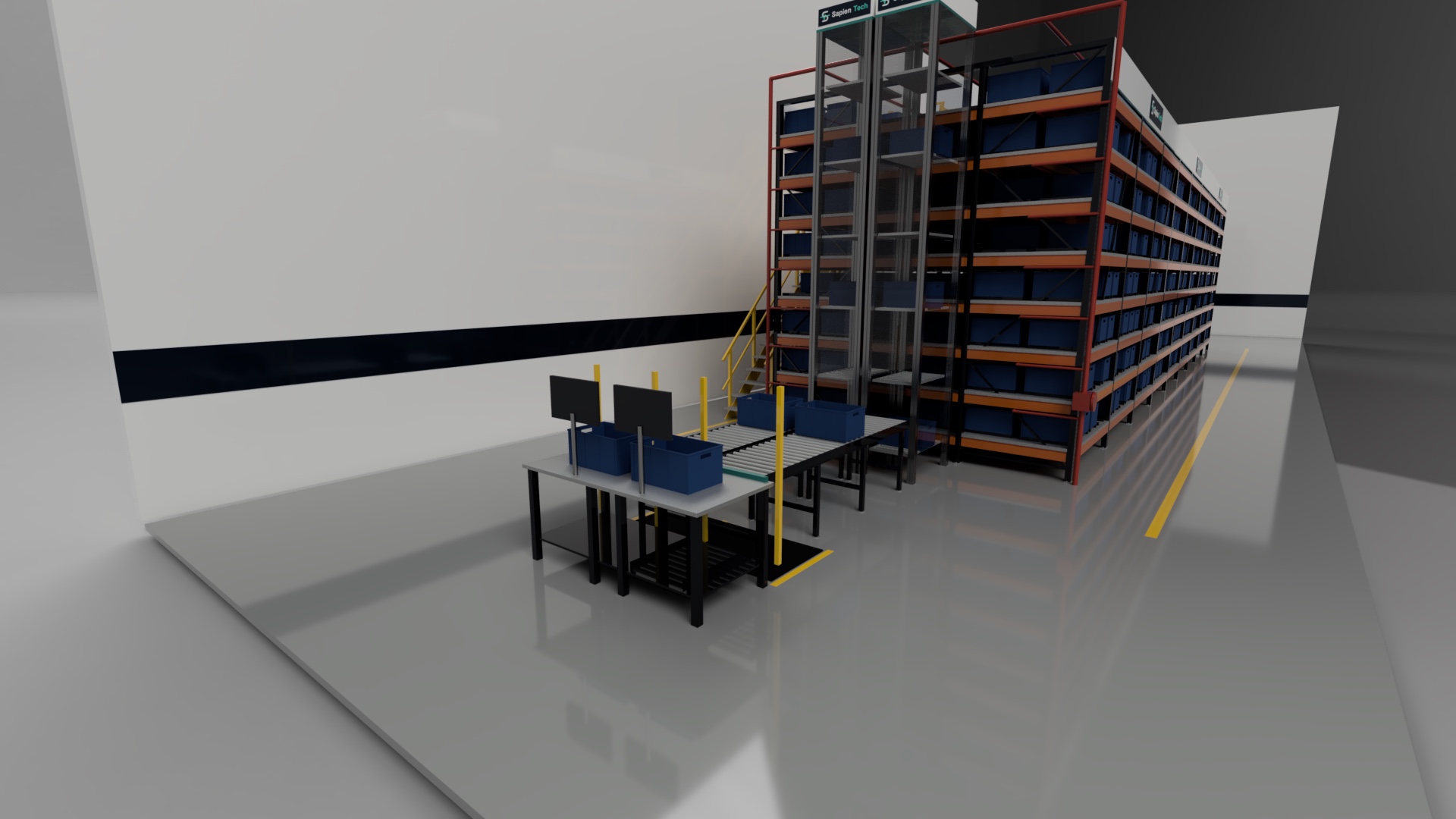
Built to be checked.
Plain rules a site team and an insurer can follow.
- Sprinklers. The model reserves space for in-rack and overhead protection. The fire engineer sets the layout, clearances and water demand for the goods and structure, with the insurer and local authority.
- What not to store. Flammable liquids, aerosols and lithium batteries need a specific fire-risk assessment and agreed storage strategy.
- Guarding. The design includes perimeter guarding and access doors. Protective devices and safety functions must be assessed and validated for each port and zone.
- Zone lockout. The model shows a separated zone B. Any continued operation in zone A depends on validated guarding and isolation. See it →
- Service catwalks. Grated catwalks on both outer faces, at two heights, reach every tote face from outside.
- Stairs, not ladders. Stairs with handrails and toe boards are planned for catwalk access. Dimensions and access arrangements need detailed design verification.
- Interlocked doors. Access doors and interlocks are part of the proposed safety design. A status light does not verify energy isolation or permission to enter.
- Fire. In-rack sprinklers both sides, smoke detection along the top, call points, extinguishers and lit exit signs at each stair.
- Quick swaps. A carrier swaps out through a waist-height drawer in the base. Lane drive tiles lift out with 4 bolts.
- E-stops. At every port, the control cabinet and along the guard.
Source: Lockton, the risk evolution of automated storage systems. The final fire design is set with your insurer and local fire authority.
Small items, many lines, fast orders.
Anything that fits a 600 × 400 × 280 mm tote and up to the design load. Bigger or heavier goods go to pallet storage.
- E-commerce and retail. Many small orders a day, same-day cut-off times.
- Spare parts and MRO. Thousands of slow-moving parts, found in seconds.
- Pharma and healthcare. Locked storage, full traceability, batch and expiry control in WCS.
- Chilled grocery. Micro-fulfilment in a cold zone. Cold chain →
- Manufacturing kitting. Kits built at the port and sent line-side by AMR.
- Returns. Checked items go straight back into a tote and are sellable again fast.
Less space, less walking, fewer errors.
Market figures for goods-to-person storage. They are other makers' and integrators' numbers, not our test results.
Better use of floor space than manual picking, mostly by removing wide aisles.
Industry benchmarkMore storage in the same building, one 3PL case study.
Industry benchmarkPer goods-to-person port, against 50–100 lines/h for a person walking the aisles.
Industry benchmarkOf a manual picker's time is spent walking. Goods-to-person removes most of it.
Industry benchmarkOrder accuracy reported for goods-to-person systems.
Industry benchmarkPer small storage robot on the market (10 robots ≈ 100 W). Our carriers ride on contactless power.
Industry benchmarkOur port work height. The operator stands still; totes come to them.
Our design targetStorage runs lights-out at night and re-sorts for the next shift.
Our design targetBenchmarks are makers' own published figures, not independent tests. Our targets are not yet measured. Sources: Exotec, guide to goods-to-person automation · Active Ants case study (AutoStore) · AutoStore, small robots use less energy · SSI Schäfer, person-to-goods vs goods-to-person.
Four lifts. Defined recovery paths.
These are proposed recovery options. Fault impact, available capacity and safety separation need testing; some failures may require a whole-system stop.
- Four independent lift units. W1 and W2 sit directly side by side at the west end; E1 and E2 do the same at the east. An alternative unit can serve only stock and ports reachable through permitted routes. A failure can still stop a wider area.
- Four downstream ports. Each loop unit has its own connected conveyor and operator station away from the lift pair. Separate port operation depends on routing, validated safety boundaries and the approved task method.
- Spare carriers. A failed carrier is intended to be recovered through the service access using an approved method. Some faults may require a wider stop.
- Two sides, two zones. Work inside a zone requires the approved isolation and access procedure. The other zone may run only with validated separation.
- Predict watching. Vibration and temperature trends are intended to support inspection and planned work. They do not detect every failure.
What it should do.
Each number says where it comes from.
Design calculation for the store in the main image, set by its four stations. Back-row digging is not yet modelled, so it must be simulated before it is promised.
Our calculation8 levels × 72 places per side, two rows deep each side of the double lane, in an 18.9 m store with 32 magnetic carriers.
Our calculationTop pick ports on the market today.
Industry benchmarkUp/down loop speed. A carriage passes each stop every 1.5 s (about 0.6 m/s).
Our design targetContinuous vertical conveyors, maker figure.
Industry benchmarkEach pick needs two tote trips of about 8 s. 600 picks/h keeps about 3 carriers busy.
Our calculationSeparate westbound and eastbound travel through the central pickup area. Transfer occupancy and order mix still constrain capacity.
Our calculationPublished speed limit for Beckhoff XPlanar movers, subject to application.
Industry benchmarkAutoStore-reported average uptime across its high-throughput installations.
Industry benchmarkDevelopment task: Beckhoff lists 4.2 kg single movers and coupled groups above 20 kg. Our 30 kg loaded-tote assembly, adapter and tile layout still need qualification; the visual does not establish this payload. Benchmarks are makers' own published figures, not independent tests. Our targets are not yet measured. Sources: AutoStore: high throughput · Geek+ RoboShuttle Hyper · Barron: continuous vertical conveyor · Beckhoff: XPlanar product specifications · Beckhoff: XPlanar movers · Toyota: AutoStore bins.
Grow the magnetic ASRS.
Start with one module. Add the same complete module with two one-way travel lanes on each magnetic floor, two independent West lift units and two independent East lift units. Every lift has its own in / out port.
- Storage positions
- 1,152
- Active magnetic floor carriers
- 32
- Independent loop lifts
- 4
- Loop carriages
- 64
- In / out ports
- 4
- Service spare carriers
- 1
- One-way level lanes
- 16
Each module: 18 columns × 8 rows × 8 levels = 1,152 storage positions. The central pickup route has two one-way lanes on every level: one westbound and one eastbound. WEST 1, WEST 2, EAST 1 and EAST 2 are four separate lift units, each with its own continuous loop, 16 carriages and port. The 32 active thin floor carriers lift totes from the twin support bars; 1 service spare is counted separately.
Four independent lift identities in every module
| Module | Lift unit | Loop identity | Port identity | Carriages |
|---|---|---|---|---|
| M01 | M01 WEST 1 | M01:T-LIFT-W1 | M01:T-PORT-W1 | 16 |
| M01 | M01 WEST 2 | M01:T-LIFT-W2 | M01:T-PORT-W2 | 16 |
| M01 | M01 EAST 1 | M01:T-LIFT-E1 | M01:T-PORT-E1 | 16 |
| M01 | M01 EAST 2 | M01:T-LIFT-E2 | M01:T-PORT-E2 | 16 |
The live machine above shows one magnetic module with four independent lift units. This assembly plan does not simulate movement between modules. Totals are storage positions and installed equipment counts. Throughput does not automatically multiply when modules are added; receiving, picking, packing and dispatch need separate sizing.
1 complete module: 1,152 storage positions, 32 active magnetic floor carriers, 4 independent loop lifts, 64 loop carriages and 4 ports. 1 service spare carrier listed separately.
Start with your totes.
We size the aisles, racks and robot count around your goods and orders.
Tote size and weight
We fit the carriers and cell size to your tote.
Levels and loops
Level count and loop count follow your building and order rate.
Ports and picking
Ports feed conveyors, picking cells or people.
Tote storage questions.
Can I order this now?
Not yet. The magnetic tote floor is in development. We can plan a project with you now.
How fast is it?
That depends on carrier count, lift count, levels and the order mix. We publish figures once they are tested.
What goes in a tote?
The target is a total tote load up to 30 kg, subject to carrier and system validation. Goods suitability, dividers and identification are agreed for each project.
What if the power goes off?
Load retention, a controlled stop and recovery after power loss are development requirements. The final design must prove these behaviours in testing; restart follows the approved recovery procedure.
Does it need a sprinkler system?
Fire protection depends on the goods, building and storage arrangement. A qualified fire engineer develops the strategy with the insurer and local authority.
What should I send you?
Tote size and weight, number of SKUs, order lines per hour, building size and picking needs.
The store from the stations.
A closer view of the same engineering model: the west pair of loop lifts, the conveyors to two operator stations and all eight storage levels. The east pair mirrors it at the far end.
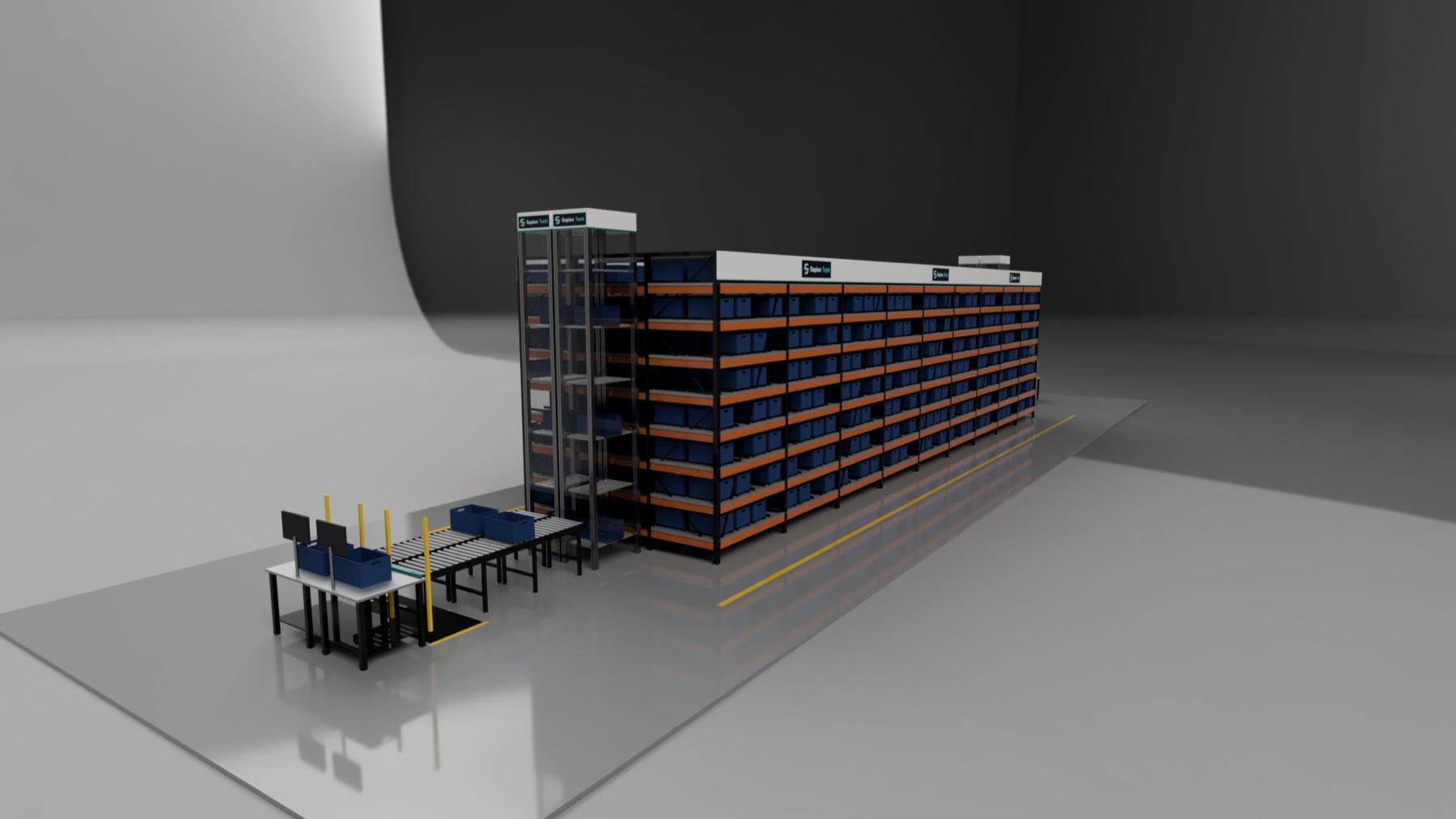
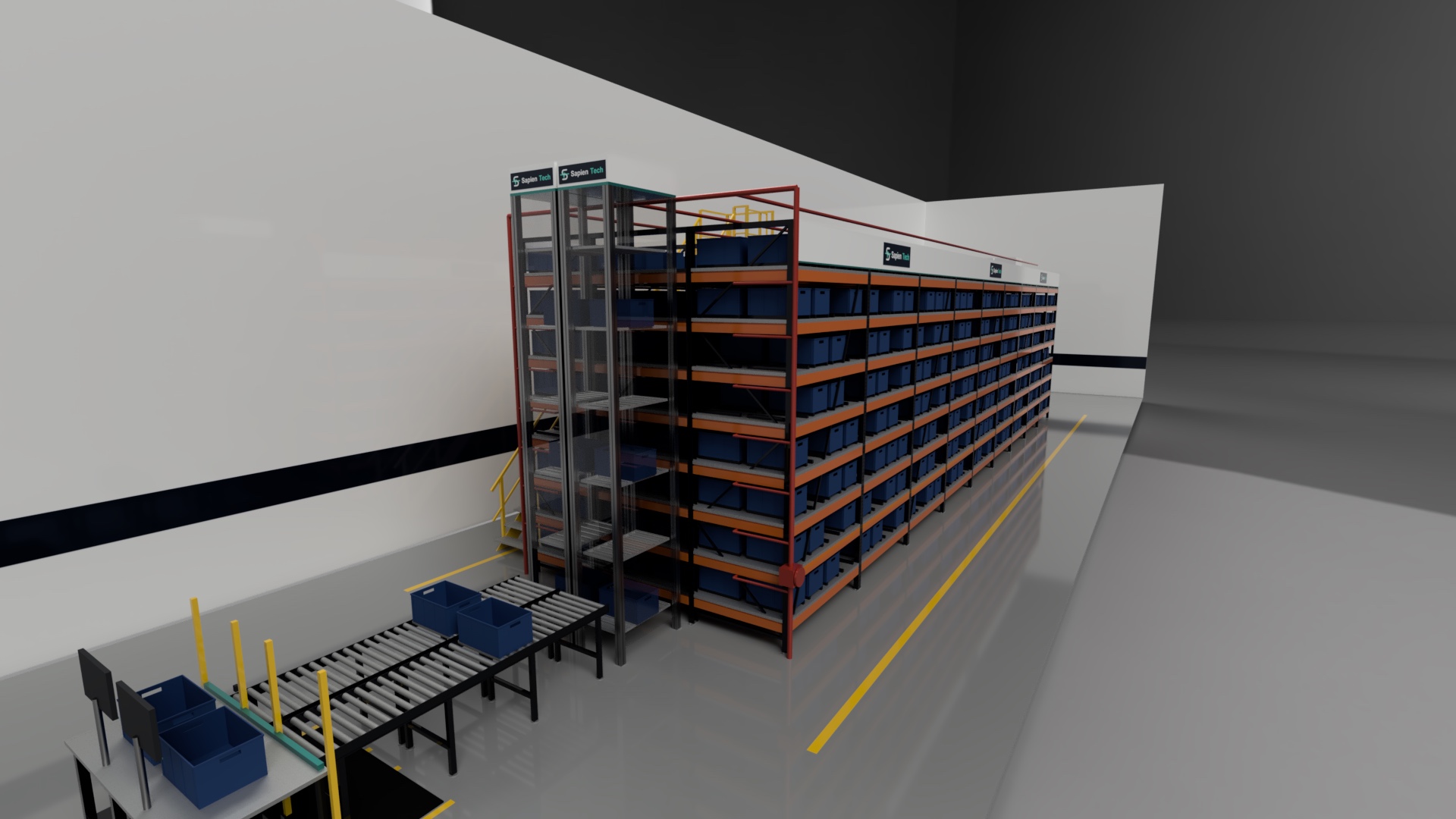
- Levels
- 8 at 570 mm
- Places
- 1,152
- Store length
- 18.9 m
- Design rate
- 1,600 totes/h; to simulate
Concept · 3D design Figures are design calculations from the Fusion model. No physical testing yet; ratings are published only after testing.
Tell us about your totes and orders.
Share tote size, weight, order profile and space. We will tell you what could work.