Home / WCS Warehouse Control
One load identity. A confirmed destination.
WCS coordinates receiving, storage, picking and dispatch. Each move needs a known load, an available destination and a connected route. Maintenance by design starts with knowing what an unavailable asset affects and which alternative is actually usable.
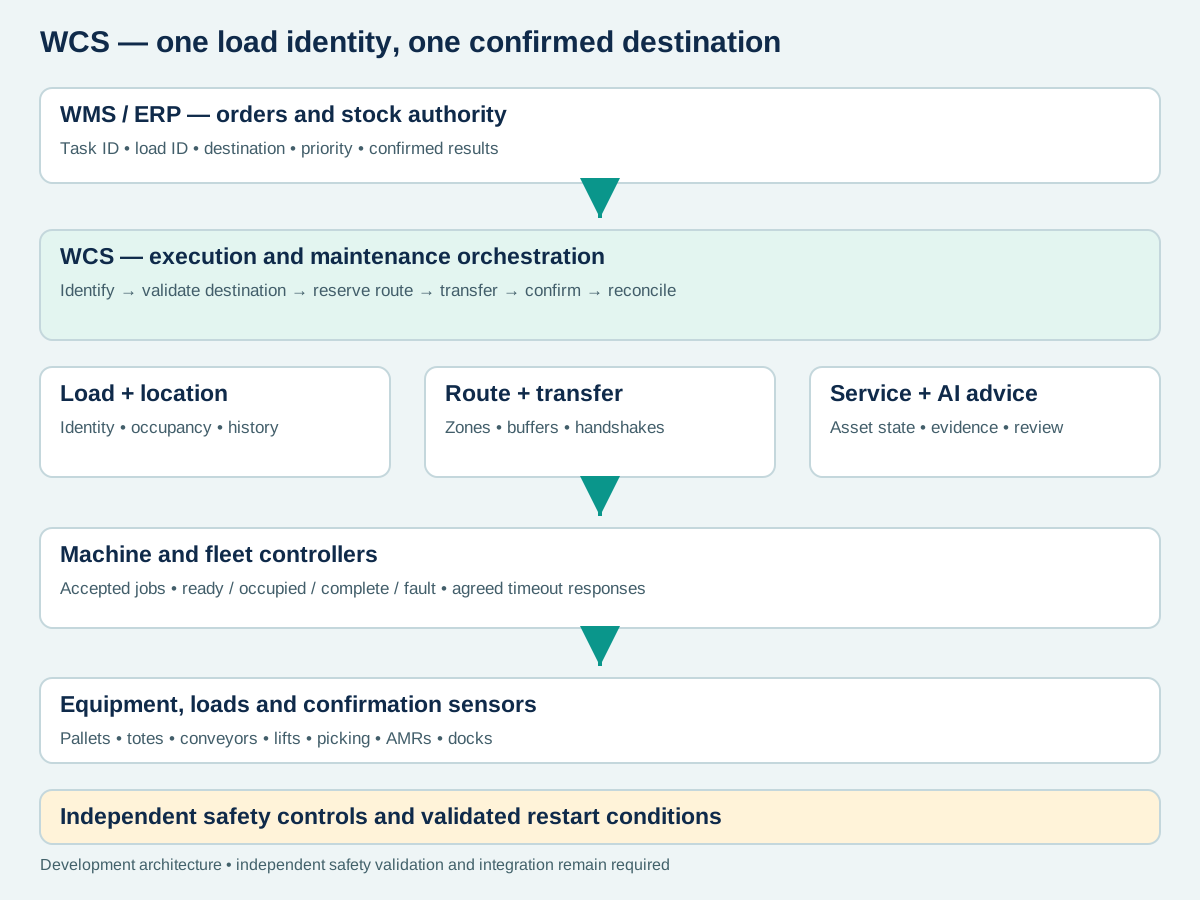
A handover, not a disappearing pallet.
The intended WCS contract keeps the same load ID through receiving, lift transfer, a real storage slot, retrieval and dispatch.
Identify the load
Read the pallet, tote or carton ID and check its profile. Unknown or incompatible loads go to a defined exception position.
Confirm the destination
Check the allowed load type and level, slot occupancy, buffer capacity and the receiving machine state before release.
Reserve a connected route
Reserve transfer zones and shared junctions. Failed or isolated assets remove their connections from the available route graph.
Handshake the transfer
Sending and receiving controllers agree readiness and completion. Presence and position evidence confirm the handover.
Commit the new position
Release upstream reservations only after confirmation. Update execution occupancy and report the result to the WMS.
Reconcile before restart
After a timeout or interrupted move, retain the last confirmed state. Check physical presence, task ID and destination before retry or reassignment.
This is a proposed control contract. The local review demonstrates model routing; it does not establish a connected PLC, WMS or production gateway.
Nine connected WCS functions.
A protocol name alone does not prove compatibility. Interfaces, supported messages and failure responses must be agreed for each machine.
| Function | Control responsibility | Connected evidence |
|---|---|---|
| Load identity and occupancy | One execution record per load. WMS remains stock authority; confirmed handovers update the execution position and slot occupancy. | WMS, scanners and presence sensors |
| Order orchestration | Release and balance tasks against available routes, buffers, ports and staffing. | WMS, picking and dispatch |
| Fleet coordination | Issue accepted tasks, route reservations and charging plans through agreed fleet interfaces. | AMR and AGV fleet managers |
| Conveyor and sorter | Arbitrate merges, accumulation and divert decisions; use a defined no-read destination. | PLCs, scanners and cameras |
| Storage and lifts | Reserve the destination, transfer and lift; reconcile storage and retrieval handovers. | Storage controllers, lift PLCs and shuttles |
| Maintenance and Predict | Connect condition evidence, asset status and work orders to service access and available alternate routes. | Predict gateway, technicians and service records |
| Dashboard and history | Show load position, route availability, alarms and data quality. Rates and OEE need agreed definitions and valid events. | All connected modules |
| AI advice | Offer evidence-linked maintenance, queue and slotting suggestions for authorised review. | Condition, vision and event data |
| Simulation and acceptance | Exercise normal work, faults, recovery and restart against explicit acceptance cases. | Shared route model and test environment |
Stop admission. Re-route. Service. Verify the return.
An alternate line needs a physical connection, a working interface and spare capacity. A grey line alone is not a backup.
Define the fault domain
Mark the affected drive, zone, lift or cell unavailable. Show the actual affected destinations and stock.
Check the remaining path
Verify every required connection, buffer and destination. Show reduced capacity and inaccessible stock honestly.
Prepare the service work
Identify the asset, evidence, spare module, tools and access point. Physical access follows the approved site isolation method.
Control the recovery
Reconcile loads and reservations, complete required checks and obtain authorised release before admitting work.
Connect each layer with an agreed contract.
REST, OPC UA, MQTT, VDA 5050 or documented PLC links may be selected for each integration.
WMS: task and stock authority
Agree task IDs, load IDs, destinations, priorities, ownership, retries and confirmed results.
Machines: readiness and completion
Define ready, occupied, transfer, complete, blocked and fault states. Test timeouts and duplicate messages.
Sensors: evidence and quality
Readings include asset ID, sensor position, units, event time and quality. Stale or missing data stays visibly unavailable.
Local and cloud roles, internet-loss behaviour, permissions and retention are selected and tested per deployment. Public demo figures are simulated.
WCS coordinates. Independent controls protect.
A route reservation or software maintenance state is not a protective function or proof of energy isolation.
Independent machine safety
Risk assessment defines and validates protective devices, safety controllers, stopping zones and restart conditions. WCS and AI must not bypass a safety inhibit.
Controlled access and records
Named access, least-privilege interfaces, network boundaries and audit records are requirements to assess and verify for the deployment.
Failover is one layer
Server, network, power and machine failures need separate tests. A second server does not create a physical bypass or prove that a move can finish.
Test the uncomfortable cases.
Track one load through its complete journey, then repeat with the proposed failures.
No duplicate load
Replayed messages and controller restarts must not create a second task or stock record.
No occupied destination
A full buffer, reserved junction or occupied slot blocks new admission until its contract allows release.
Honest failure response
Test each line or lift failure, combined failures and shared dependencies. Show lost access and capacity.
Evidence before recovery
Test communication loss, interrupted handovers and restart reconciliation before production release.
WCS questions.
Practical questions
Do we still need a WMS?
The WMS normally owns stock and orders. WCS coordinates execution and reports confirmed outcomes. Responsibilities for a smaller site must be agreed explicitly.
Can it run machines from other makers?
Only where the required control and data interfaces are documented, supported and tested. A shared protocol alone is not enough.
What if both routes are unavailable?
Affected work stays blocked or uses an approved exception process. The dashboard must show inaccessible stock and destinations; WCS must not invent a route.
Is this a connected production system?
No. This is a local development review. Real machine, WMS, failover and data integrations require implementation and acceptance.
Start with the flow and the maintenance problem.
Share load types, equipment, destinations, recurring delays and maintenance constraints. We will define the evidence, interfaces and acceptance cases with your team.