Home / Boom conveyor
Into the trailer. Right to the stack.
Our telescopic boom conveyor runs out of the dock and into the trailer. Cartons and totes arrive at the stack, so nobody walks them in.
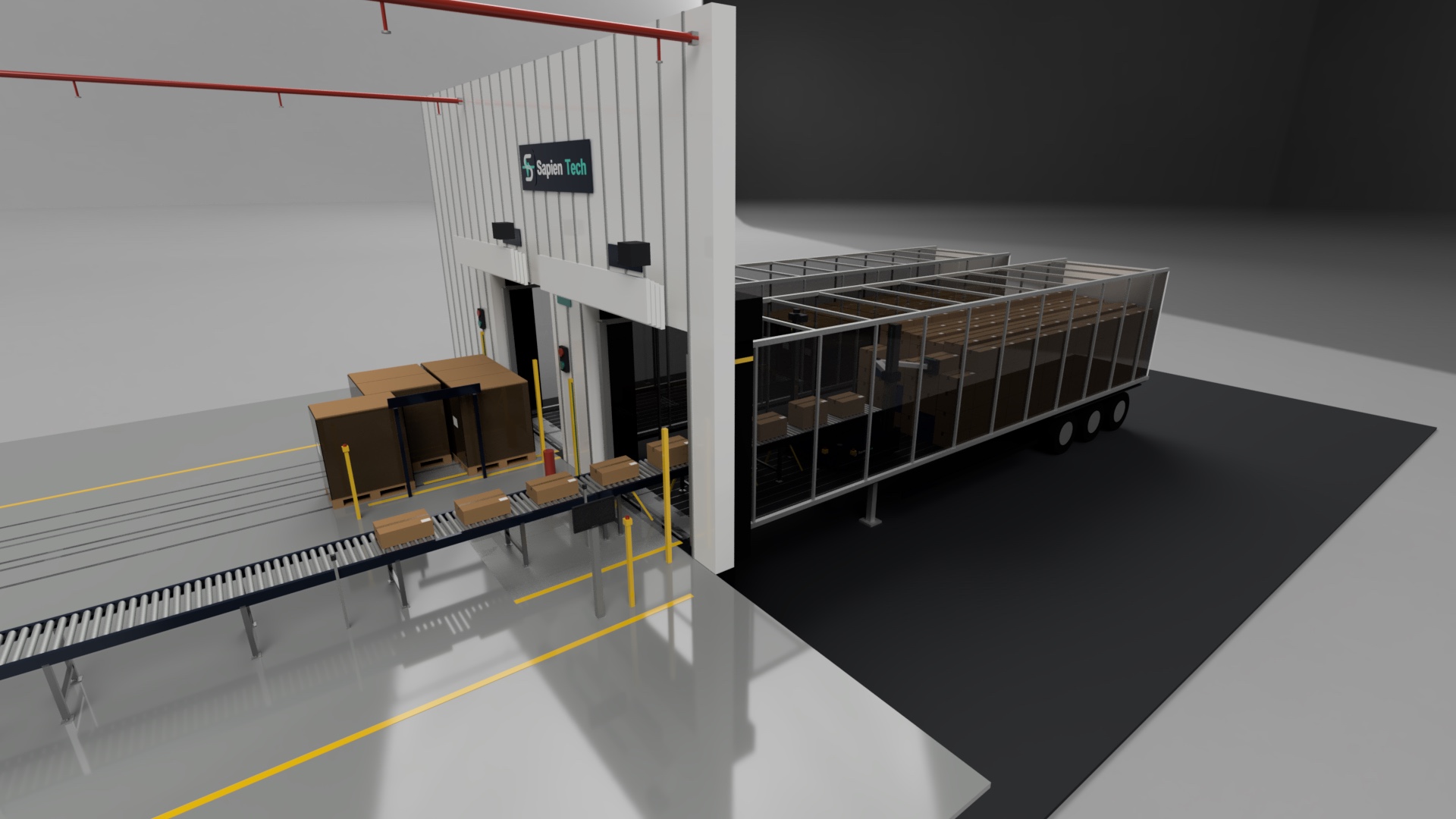
It grows into the trailer, then steps back.
Four stages slide out of a fixed base. The nose tilts to the height of the row being built.
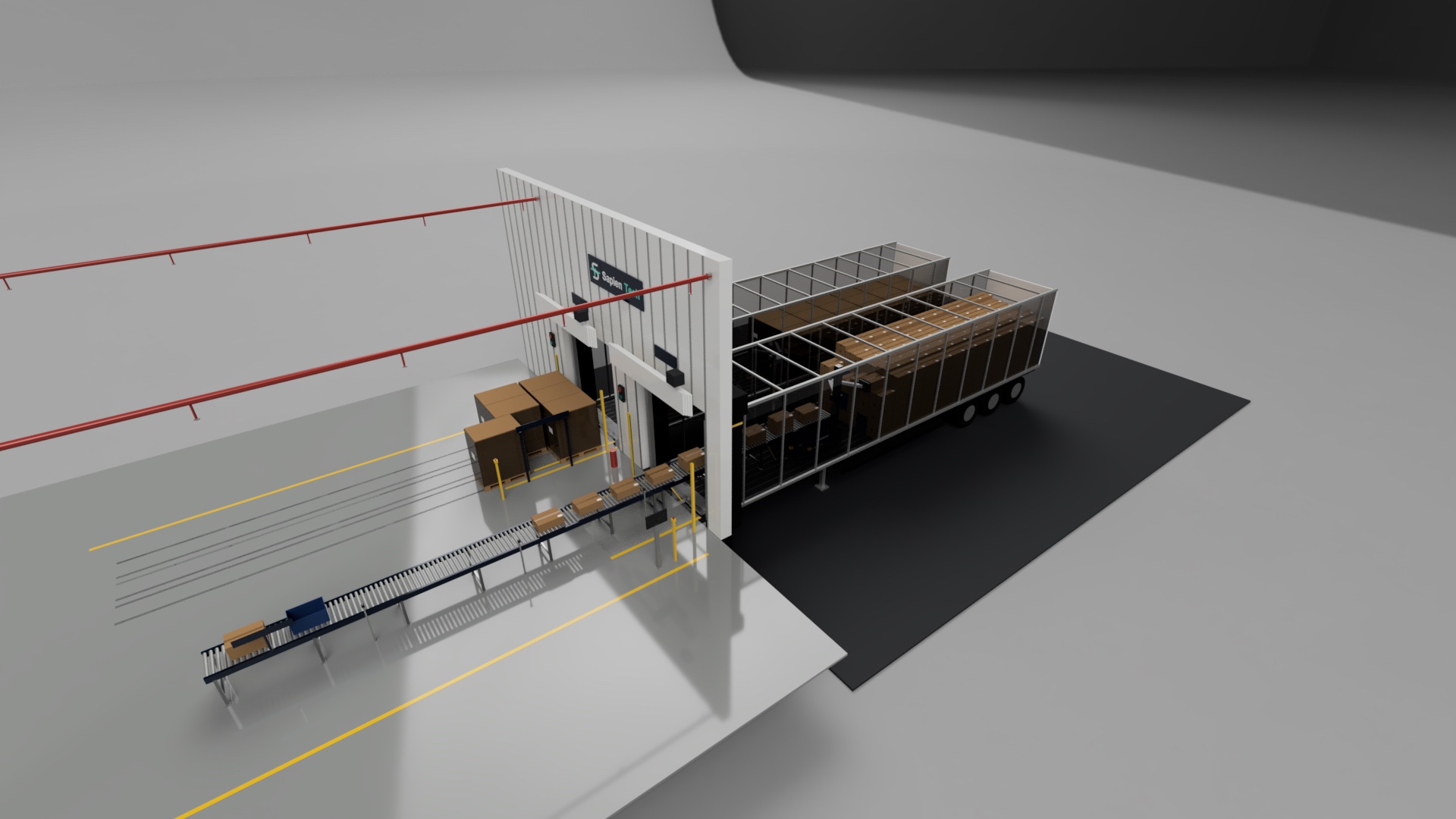
The 3D model runs faster than real life so the whole cycle fits in about half a minute.
- 1. Dock ready. The trailer is at the door. The dock light turns green and the leveller bridges the gap.
- 2. Extend. The operator drives the boom into the trailer from the nose panel. Four stages slide out of the base.
- 3. Set the height. The nose tilts down for the bottom row, then up for the next.
- 4. Load. Cartons and totes ride the belt from the infeed to the nose. The operator places each one in the wall.
- 5. Step back. As the wall grows, the boom retracts a little at a time.
- 6. Park. When the trailer is full, the boom goes home inside the building and the dock light turns red.
Everything is at the nose.
The person in the trailer controls the boom, sees well and can stop it from anywhere.
- Nose panel. In, out, up, down and belt run, with an e-stop on the panel.
- LED work light. Lights the stack face inside a dark trailer.
- Safety bumper. A yellow bumper on the nose stops the boom on contact.
- Pull-cord. A red cord along both sides of the base stops the belt from any point.
- Photo-eyes. At the infeed and the nose, so items never pile up.
- Beacon. Flashes while the boom or the belt is moving.
- Mixed loads. Cartons and our 600 × 400 × 280 mm totes on the same belt.
- Predict built in. Our sensors watch drive motors and bearings for early wear.
The numbers in one place.
Design and target values for this machine. None are tested yet unless marked Market. On a phone, swipe the table sideways.
| Item | Value | Type |
|---|---|---|
| Reach into the trailer | About 10 m past the dock (4 stages of 2.55 m) | Design |
| Fixed base | About 4.1 m long, inside the building | Design |
| Belt width | Around 800 mm | Design |
| Belt speed | Up to 0.5 m/s, variable | Target |
| Load on the belt | Up to 60 kg per metre | Target |
| Items | Cartons and 600 × 400 × 280 mm totes | Design |
| Nose | Articulated, tilts up and down to the stack height | Design |
| Controls | Nose panel, HMI cabinet at the base, Predict sensors | Design |
| Safety | E-stops on the nose and both sides, pull-cords, bumper, beacon, photo-eyes | Design |
| Standards we design to | EN 619 for unit-load conveyors, EN ISO 13849-1 for safety controls | Design |
What the market does today.
Each number says where it comes from.
Longest extended length of a market telescopic belt conveyor.
Industry benchmarkHighest belt load quoted for a market unit.
Industry benchmarkBelt speed range of a market unit, variable drive.
Industry benchmarkTypical number of telescoping stages; extends at 12 m/min.
Industry benchmarkLoading time a market supplier says telescopic loading can save.
Industry benchmarkOur reach in the 3D model: 4 stages of 2.55 m.
Our design targetMarket numbers are makers' own published figures. Our numbers are design targets, not tested yet. Benchmarks are makers' own published figures, not independent tests. Our targets are not yet measured. Sources: Caljan Rite-Hite telescopic belt conveyors (SpecifiedBy) · Alstrut telescopic conveyors brochure · BEUMER telescopic loose loading · BS EN 619:2022 (BSI).
Three things we need to know.
We size the boom around your trailers and loads.
Trailers
Lengths, heights and how often each dock turns a trailer.
Loads
Carton and tote sizes, weights and how they are stacked.
Link
Where the infeed comes from: sorter, storage or a pick area.
Boom conveyor questions.
Is it for sale?
Not yet. It is in 3D design. We can plan it into your dock layout now.
Can it unload as well as load?
Yes. The belt runs both ways. For unloading, the operator puts items on the nose and they ride back into the building.
Can it serve more than one door?
Yes. The base can run on floor rails and move between doors.
Does it link to the rest of the site?
Yes. The infeed connects to our sorter, tote storage or AMRs, and our WCS plans which trailer gets which load.
Tell us about your docks and trailers.
Share trailer types, loads per day and your dock layout.